
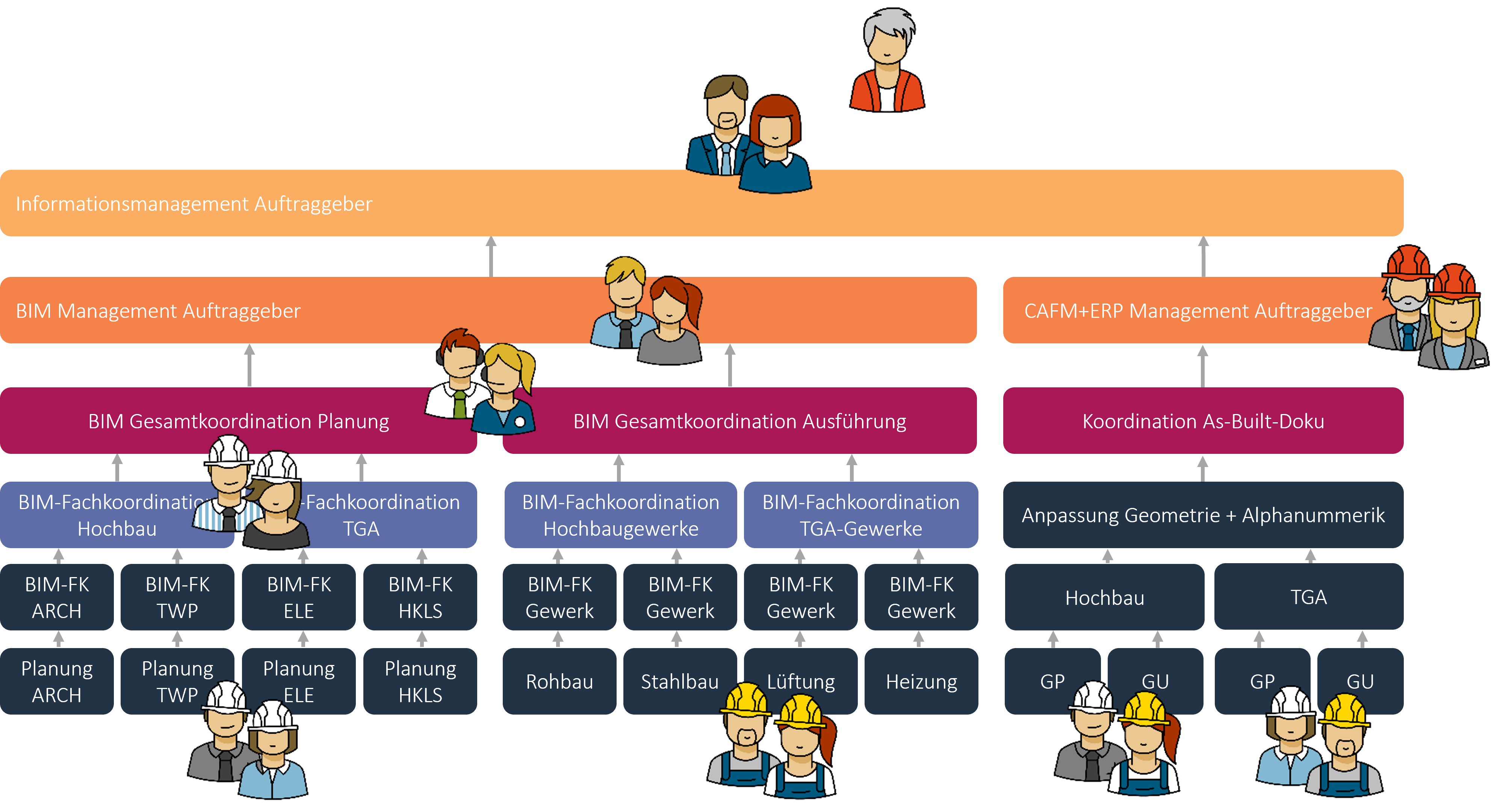
BIM-based collaboration involves new areas of responsibility compared to traditional CAD design. These tasks are handled by personnel specifically designated for this purpose. The overarching goal is seamless digital collaboration and high-quality data and geometric models.
This article describes the most important of these from the contractor’s perspective. Please also note the reference to the advanced course on roles and functions in BIM workflows.
If you'd like to learn more about this topic, feel free to check out the video course on the roles and functions of the BIM workflow:

BIM management oversees the BIM services provided by the design team and assists in the handover of the consolidated BIM models to the client. This service should not be confused with project management. It is responsible for setting up the BIM project and organizing the management processes related to digital project execution. In this way, it ensures consistent handling of model-based work and its integration into other documents.
Responsibilities
- Implements the client’s information requirements regarding digital project management.
- Collects and delivers the content of the digital project management to the client.
- Serves as the primary point of contact for questions regarding digital project management between the client’s information manager and the overall BIM coordinator.
- Organizes and manages the digital project management and execution on the part of the Contractor in accordance with the BAP.
- Represents the Contractor vis-à-vis the Client’s information management.
- Implements the management processes related to digital project management.
- Advises the Contractor’s project management on all BIM-related matters.
- Ensures consistent model-based work through rules, standards, and processes.
- Promotes collaboration and communication within the team.
- Coordinates the provision of the collaboration platform to enable the exchange of generated materials—including graphics, alphanumeric data, and documents—among team members.
- Strategic planning for lifecycle-oriented data management
AIA/BAP
- Development of Client Information Requirements
- Development of the basic guidelines for the BIM implementation plan
- Responsible for the ongoing review of the requirements defined in the BIM Implementation Plan
Collaboration platform
- Organization (and configuration, if necessary) and use of the shared work environment.
- Coordination of external IT requirements
Data Security
- Organization and compliance with guidelines on data security, data consistency, and data distribution
Coordination
- Organizing and initiating BIM-related meetings
- Ongoing coordination with the BIM information manager
- Ongoing coordination with the BIM Master Coordinator and monitoring of the implementation of BIM requirements by project participants
Milestones
- Ensuring that BIM services are delivered on time in accordance with the milestones for information exchange
QM
- Implementation of BIM Quality Management
- Definition of Quality Assurance Processes
Training
- Design and implementation of project-specific training (in-house or external)
Standards
- Initiating and adhering to the required standards for digital project management
- BIM2Field Concept
- BIM2FM design
The BIM coordinator is responsible for coordinating all participating discipline specialists and integrating their BIM models. This role is often filled by the project architect. In matters related to BIM, the coordinator serves as the primary point of contact for the BIM manager.
Responsibilities
- Reviews and forwards the digital project management content to the BIM coordinator.
- Serves as the primary point of contact for questions regarding digital planning between the BIM manager and the BIM coordinator.
- Monitors compliance with the required information quality, standards, and established procedures (best practices).
- Represents the contractor vis-à-vis the individual planning disciplines.
- Is responsible for providing the coordination model, which is composed of the individual discipline-specific models, and coordinates this across all trades.
- Ensures the provision of standards and established procedures (best practices) for the project.
- Reviews the services to be provided and approves their release.
- Prepares regular reports.
- Maintains the task list for items arising from model coordination and organizes the necessary communication strategy.
BAP
- Assisting the BIM manager in developing the BIM plan
Coordination
- Organization, management, and documentation of BIM coordination meetings
- Coordination and resolution of conflicts with the design managers
- Ongoing coordination with the BIM manager
- Ongoing monitoring and coordination with the BIM coordinator
- Organization of test runs to validate concepts and model content (e.g., common project zero point)
Milestones
- Merging and deployment of the coordination model based on the domain-specific models
- Assigning responsibility for structural grids and floor levels
QM
- Ongoing quality assurance with regard to the specified requirements
Training
- Identification of project-specific training needs
The BIM coordination office responsible for the respective department handles internal coordination regarding the creation and handover/acceptance of BIM discipline models. For BIM-related matters, it serves as the primary point of contact for the overall BIM coordinator.
She has a deep understanding of the BIM methodology and coordinates the internal requirements of digital project management with the project’s specific needs. She ensures the necessary data consistency within her respective discipline and is responsible for quality assurance of all information before it is released to other project stakeholders.
Responsibilities
- Coordinates digital project management within the relevant planning discipline on behalf of the contractor.
- Serves as the primary point of contact for questions regarding digital planning and execution with the overall BIM coordinator.
- Monitors compliance with the required information quality, standards, and established procedures (best practices) on the part of the Contractor.
- Ensures the necessary consistency within the Contractor’s discipline.
- Supports project-wide model-based collaboration within the Contractor’s area of expertise.
- Point of contact for external and technical BIM matters.
- Coordinates the contractor’s internal IT requirements with the project’s needs.
- Is responsible for quality assurance of all data before it is published.
Collaboration platform
- Use of the collaboration platform
- Coordination of internal IT requirements
Coordination
- Ongoing coordination with the overall coordinator
- Participation in BIM coordination meetings
- Implementation of the results from coordination meetings
- Point of contact for BIM-related technical issues raised by other project participants
Milestones
- Coordination with other planning disciplines regarding interfaces, data transfer, rules, and collaboration
- Timely provision of technically accurate models that meet the requirements of the milestone
- Reporting issues to the overall BIM coordinator
QM
- Coordination of digital project management within the respective planning discipline
- Responsibility for internal quality assurance within the planning discipline, reporting, planning-specific project documentation, and data management
Training
- Responsibility for ensuring that the planning discipline remains up to date to meet the project's requirements.