
A naming convention is a company-wide or industry-wide standard for consistently naming objects and using abbreviations. This is particularly important in digital, object-oriented data management—the “I” in BIM—because software processes depend on these predefined names. In practical terms, automated processes can only work as intended when the objects they use are named consistently.
This article lists the main BIM-related naming conventions and abbreviations and provides links to further information. It focuses on the conventions used for templates and families in the BOA environment.
The benefit of these standards becomes clear in everyday work: a systematically organised, consistent and familiar environment helps users work more efficiently.
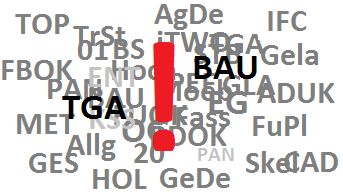
_BAU ... File-name suffix for the combined architecture and structural engineering model. Architects and structural engineers work in this model.
_TGA ... File-name suffix for the combined building services and electrical engineering model. Building services and electrical engineers work in this model.
_GES ... File-name suffix for the combined model containing all discipline models. Shared coordinates are transferred centrally from this model.
_CAD ... File-name suffix for the model used to hold all DWG files. CAD files, such as site plans, existing drawings and drawings from external parties, are loaded into this model.
_AAL ... File-name suffix for the external works model, which includes external works and topography.
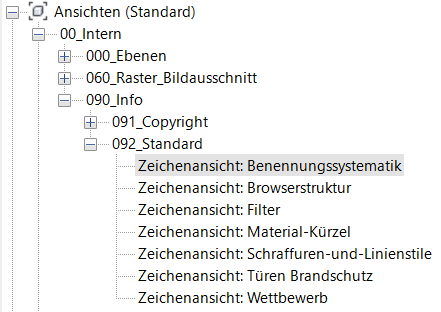
The naming convention can be found directly in Revit under 00_Intern > 090_Info > 092_Standards.
BAU
This Project Browser structure contains views for architecture and structural engineering (BAU).
TGA
This Project Browser structure contains views for heating, cooling, ventilation, plumbing and electrical engineering (TGA; HKLS and ELT in the template).
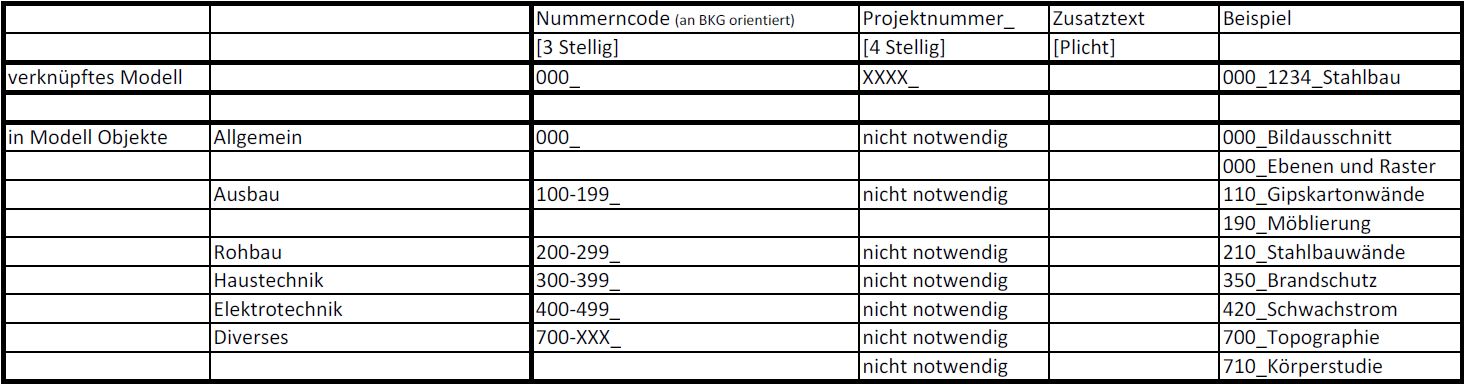
For more information about worksets, see the worksets article.
BAU
General
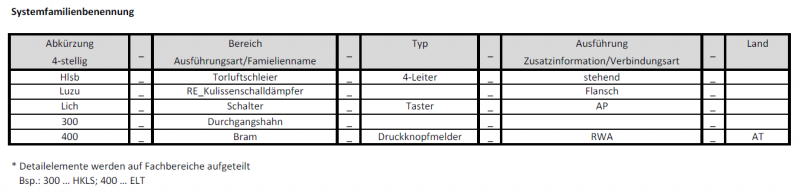
The family naming convention covers loadable families and system families.
Swept paths
Swept-path names follow this pattern:
Dtai_Schleppkurven_Fahrzeugart_Fahrzeuglänge_Innenradius_fa or ..._st
The fields specify the vehicle type, vehicle length and inner radius. The German naming components are retained as used in the families.
- fa = radius for a moving vehicle
- st = radius for a stationary vehicle
Example:
Dtai_Schleppkurven_LKW_9_5_fa means that a moving truck (fa) with a length of 9 m has an inner radius of 5 m.
TGA
BAU
TGA
BAU

TGA

BAU
TGA
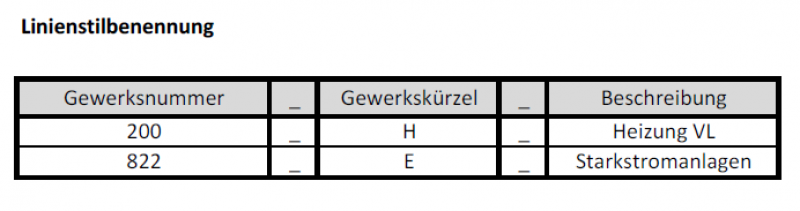
For information about naming view templates, see the View templates article.